Friday, August 12, 2011

Apples Don't Fall Far From the Tree

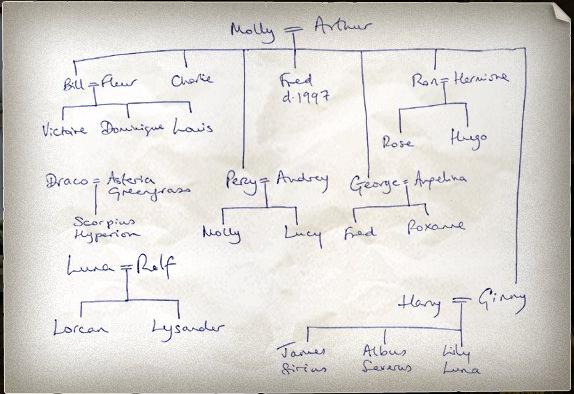
Chart of the Weasley, Potter, Malfoy, and Scamander families,
courtesy of Harry Potter Lexicon


Where did you get that red hair?

One kid I knew growing up was taught to say "from the mailman" in response to that question, because neither of his parents had red hair. But there were relatives in their extended family tree with the same phenotype - red hair and blue eyes - indicating that those recessive traits were being carried throughout the generations, but waiting to be matched with other recessive genes in order to become apparent. Because the truth of the matter is that we are all genetic combinations of our parents, grandparents, and beyond - combinations that result in physical traits that are recognizable from generation to generation.  But what lies beneath the surface - our health traits - is just as easy to spot if we think about it.

Therefore, today's HealthTwisty comes with an assignment: create a family tree. Not just one with names and dates of births and deaths, but one that includes all the health and occupational information you can mine from your family. These intergenerational facts are actually clues to your own health and can provide a road map on how to protect or enhance it.

If you've poked around HealthTwisty for awhile, you know that personal genetics or susceptibilities are the basis of much of the information here. Choices about food and our environments can work for or against our basic genetic make up, so it is important to know the genetic hand we are dealt. After all, we can't change our genetics (yet). But we can change our environments.

To get started, here are some things I'd include in a family medical history:
  • names, gender, dates of birth and death of first and second-degree family members.
  • causes of death.
  • known illnesses, allergies, and conditions, such as cancers, a penicillin allergy, arthritis, or infertility.
  • mental health issues, such as depression, addiction, or alcoholism.
  • inborn genetic issues, such as Downs syndrome or cystic fibrosis. 
  • learning issues, such as dyslexia.
  • unusual family traits, such as eyes that are different colors, premature greying, or a shock of white hair, all of which could signify underlying conditions.
  • occupations, which could account for or contribute to some diseases.
  • place of residence, such as a farm, an urban setting, or the suburbs.
  • anything else of interest.
This exercise is just a riff on what a good family physician asks about during a comprehensive exam. In recognition of the basic importance of knowing one's family history, CDC offers a computer program where family members can record and share their histories. CDC even has a campaign running in this season of family reunions that encourages people to seek health information while they are gathered together. While researching resources, I found out that the US Surgeon General has declared every Thanksgiving since 2004 as "National Family History Day" for this exact purpose. Who knew?

It's an interesting exercise. I've done a medical history for my grandparents and parents and my husband's parents and what we know of his grandparents, as well as for my husband and myself. By mapping it out, I was reassured that for the most part, both sides of my family and one branch of my husband's family generally live into their 90s in reasonably good health. But we have a lot to watch out for: different branches of our families have autoimmune diseases, cardiovascular disease, or eye problems like macular degeneration and glaucoma. Because so many of those conditions  have things you can control (like body weight to prevent diabetes) or can be screened for in order to facilitate early treatment, there are measures we can take to minimize our risks of developing them or to catch them early if they do occur.

Of course, the way genes combine is not always straightforward, which means that biology does not always equal destiny. In other words, just because one of your parents developed cancer does not mean you will. The concept of how complicated genetics can become was brought home to me years ago when I attended and wrote the report for a conference on sex and gene expression. This extremely technical conference focused on the differences in development and disease by sex and in the ways genes can be expressed. One interesting aspect called crossing-over occurs during the meiotic phase of cell division. The end result of this process is that we inherit large chunks of DNA from our grandparents. Therefore, examining your grandparents' traits may be as important as your parents' in determining your genetic make up.

Further, it is established that diseases such cancers need a series of mutational hits to form, so merely the presence of a genetic mutation that puts you at higher risk does not mean a cancer will develop.  This is why it is important to consider the environmental aspects of family members' diseases. For example, if you have a grandfather who died from lung cancer, it would be good to know if he smoked, if he worked in the construction industry where he may have been exposed to asbestos, or if he was a lawyer exposed to nothing more harmful than fumes from the copy machine. If he smoked or worked with asbestos, chances are those external factors caused his lung cancer and therefore you are not at increased risk of developing it (as long as you don't smoke or work with asbestos!).

This type of observation costs nothing more than your time spent in putting it together. You can also opt to spend some money and purchase a personalized genetic test. For about $100-$500, you can find out risk factors for certain diseases, the presence of carrying a heritable disease, and how you might react to certain drugs.

For the most part, these tests tell you that you may have the genetic makeup that predisposes you to something, but can only provide a relative chance that disease will actually develop unless the disease is a genetically dominant, like Huntington's Disease. Further, there are many steps involved in gene expression that are not captured by a recitation of the base pairs.  However, overall, these tests can be very useful - especially if you don't have information on your birth family.

Making a family history of health is not a quick process. Many people only remember what relatives died from, but not illnesses or conditions for which they may have been treated during their life. Or they may not think it important to recall that Grandpa Joe immigrated from an impoverished country where he was malnourished during his early years - a factor that could help explain his short stature and weak bones. So some probing and detective work may be required. Even only mapping your immediate family can be beneficial and may provide information to better manage your health. If you have kids, giving them a family health history can be important, not only for their current health, but in the future as the field of genetics advances in great strides.

In honor of the final Harry Potter movie, I chose the illustration at the top of this article that maps out the family trees of some of the most well-known wizards of our time. But there's nothing magic about genetics (even though there are surprises, like red hair popping up every now and then) and making a family health history can take away some of the mystery behind illnesses or just plain not feeling as well as we should. Using these clues to make sense of our own health and adjusting our environments accordingly is something even us Muggles can get behind!

###


Sunday, July 24, 2011

Maybe it's Not All in Your Head

Para nuts, fresh from the rain forest, at the outdoor market
 in Belem, Brazil
Everyone knows that food can cause all sorts of physical effects on our bodies. Sugary desserts can cause cavities, sodas can leach calcium out of our bones, and too many carbs can make us soft and push us toward diabetes. None of that is disputed.

What is disputed, and is a topic of ongoing research, is the effect certain foods have on our mental health. There is a growing body of evidence showing that for certain individuals, some foods can cause mental fogginess, depression, anxiety, and can aggravate more severe mental issues, such as schizophrenia. The flip side to that cause and effect is that removing the offending foods may allow individuals to alleviate their symptoms and eliminate or reduce certain medications - a very promising concept.

Before I go on, a quick fact: did you know that about 10% of all adults in the United States (and about 2% of all children - yikes) have prescriptions for anti-depressants? And that number doubled between 1995 and 2005 (coinciding with the advent of direct-to-consumer advertising, by the way). So there are a lot of people out there being medicated for depression.

Let me state up front that I believe some individuals do have brain chemistries that can benefit from anti-depressants. And for those individuals, medications can be lifesaving. However, I am suspicious that 1 in 10 adults in the United States need an anti-depressant. Therefore, I do wonder if there are commonalities in our environments, like, say, an intolerance to wheat or dairy products, or an inability to process ever-increasing amounts of sugar, that affect the brains in individuals with susceptibilities to those products.

There is a lot of interest in the food/brain connection.

Recently, Alice Bradley, the talented writer of the blog Finslippy, wrote about her new diet that eliminated wheat, dairy, sugar, and grains, and focused on fruits, vegetables, and protein. After only a few weeks, she was able to wean herself off of Remeron, Klonopin, and sleep meds, retaining only her prescription for Prozac. If you Google "wheat and depression," you get 11,900,000 hits. Google sugar and depression and you get a whopping 30,600,000 hits. Part of the interest in sugar can be traced to Gary Taubes' fascinating New York Times article on the perils of sugar.

However, once you delve into the research behind the claims, you are quickly confronted with a wide divide between medical professionals who believe food intolerances can cause all sort of mental problems and those who pooh-pooh the entire concept, chalking up any gains made in mental health from altering one's diet to the placebo effect. It's confusing.

A lot of the confusion comes from the research not catching up to the anecdotal evidence. Mental health is difficult to quantify because symptoms are, for the most part, self-reported. Depression and anxiety can vary from person to person and treatment success often boils down to, "I feel fine." But the fact that the placebo effect exists tells us that there are still many mysteries in medicine that cannot be fully explained by science.

Despite the problems with quantifying mental health, there has been compelling information published on how the gut is like a "second brain," with its own nervous system operating independently of the brain. A new field, neurogastroenterology, has been proposed to better understand how the gut mediates the immune response, and there are even murmurings of psychiatry expanding to include treatment of this second brain in addition to the one the field currently focuses on. (Side note: sounds a bit like holistic medicine, no?).

Further, research on the different antibodies, IgE (immediate ones associated with hives and anaphylactic shock) versus IgG (delayed ones associated with food intolerances, a concept that current medical practice does not fully embrace), is plodding along. Fascinating stuff from an academic perspective. But frustrating when you are interested in the practical application of the information. Thus far, no one has scientifically mapped out why foods being digested in the gut can have effects on the brain. So a lot of medical professionals are skeptical of any food/brain effect link.


But I don't think you need clear-cut answers in order to move ahead with managing your health. If you are being treated for anxiety or depression you might want to talk to your doctor about trying an elimination diet to determine if some of the common allergens, such as wheat, dairy, or soy, could be underlying or contributing to your condition.  Here is information on elimination diets, and a good nutritionist can guide you through the challenges of what may at first seem to be a daunting task.

I look forward to the emerging research that will map out how our second brain interacts with our "first" brain. Until then, I think there is enough information to encourage us all to look closely at the link between our diets and our mental health.

###


Thursday, July 21, 2011

The Green, Green Grass of Home Part II

Just a few weeks ago, I wrote about lawn chemicals and their effects on children's health. Today I learned that that EPA's science advisors will be delivering the results of a two-year study on atrazine, one of the most common weed killers used in the United States. You can weigh in on this issue over at Takepart, the advocacy arm of Food, Inc. Lots of good links on that page, too.

###

Sunday, July 10, 2011

This is So Bad

Trust for America's Health and the Robert Wood Johnson Foundation have released their annual obesity statistics, and they're not pretty. See that map above? See how it's mostly red? That means over 25% of the adults living in those states in 2010 were not just overweight, but obese. Kids don't far much better. Click here for the children's obesity map, as well as interactive maps for both populations, and the full report (fittingly titled "F as in Fat: How Obesity Threatens America's Future").

What's even more shocking to me than the high percentages of obesity is how quickly the rates are rising. Eight states have obesity rates that are over 30%. Just four years ago, only one state was above 30%.

The report outlines troubling racial and economic disparities - more African Americans and Latinos were obese compared to whites, and more people making less than $15,000 per year were obese compared to those making more than $50,000 per year.

I'm not sure we can legislate ourselves out of this mess. A junk food tax might help pay for the end result of all the medical care that obesity-related conditions require and might dissuade some from purchasing sodas. Better labeling might enable consumers to see how much sugar is in certain foods by grouping all the sources of sugar together, for example. And subsidizing fruits and vegetables might help bring the costs of those important foods down. But the answer still comes down to education and choice. Unfortunately, changing behaviors is one of the most difficult public health challenges to take on, especially after those behaviors have become the norm. For example, if everyone you know snacks on sodas and chips, it is normal. You are odd if you choose fruit or yogurt. If you are surrounded by overweight people, that becomes the new normal for your community, which means it is accepted and even supported in the options available. Slim people may have trouble finding clothes that fit and healthy foods may be even scarcer as merchants cater to the tastes of their clientele. Those barriers are difficult to overcome.

Do you think changing the food labels like the Center for Science in the Public Interest suggests below will help? (Here is the report from which this image was taken.)


Michelle Obama is trying to bring attention to this issue, and kudos to her for using her platform as First Lady for this issue. States are trying to address the problem through school lunch nutrition guidelines and other legislation. But the problem just keeps getting worse. Any ideas?

Update: If you can't view the graphic for the food label, following the link to the report. The graphic is on page 10.
###

Wednesday, July 6, 2011

The Green, Green Grass of Home

My neighborhood is very diverse when it comes to yards.

Directly across the street from me lives the former president of my state's organic farmers society. Because his front yard gets a lot of sun, he has transformed it into a yard/garden, with tomatoes, peppers, squash, eggplants, sunflowers and more. He has planted fig trees, locust trees, and blueberry bushes. When I walk my dog past his yard in the mornings, my movements flush out indigo buntings, yellow finches, and cardinals. There are good caterpillars that turn into blue butterflies, and bad caterpillars that eat the tomatoes. There are bees to pollinate the plants, and rabbits that sneak in to nibble the greens. It is a lively place if you look closely.

At the other end of the yard spectrum are the perfectly green, perfectly clipped lawns.  The chemical trucks show up a couple times each month to visit these lawns. The drivers spray the lawns and then stick little warning signs in them noting that children and pets should stay off of them for at least 24 hours. Even though it is dangerous to walk barefoot on them, these lawns look inviting, like outdoor carpets. When I walk my dog past those lawns, I don't startle many birds.

Other lawns are somewhere in the middle. They do not receive regular pesticide applications, but the owners use chemicals periodically to treat acute problems, like fungus, or use fertilizers to boost the blooms of ornamentals.

But by far  the outdoor carpet yards outnumber the others by a significant amount in this neighborhood. 

That's unfortunate for a number of reasons. Our neighborhood is beautifully hilly. When it rains, the runoff from all of our yards drains into storm sewers and creeks. Many of those chemicals that children and pets are warned against walking on eventually end up in the water supply, where they have to be (one hopes) removed. But before they are, those chemicals affect the wildlife that live in or drink from the creeks. When we first moved to this neighborhood years ago, we would see crayfish and minnows in the creeks near our house. I can't remember the last time I have seen any forms of life in them. I try my best not to let my dog drink out of them.

But the problems with the chemicals are not just in our water supply. We can breathe them in when they are sprayed, track them into our homes, and get them on our hands when we pick up baseballs that have been hit into the next yard. Our pets pick them up on their feet, and then they lick them off (did you know up to 50% of dogs develop cancer in their lifetimes? While not all canine cancers can be attributable to lawn chemicals, some probably are. Here is a veterinarian-written article on the risk of various chemicals to our canine friends.) I've come to view these yards as dangerous to my family's health as second hand smoke.

More and more research is showing that those green carpet lawns are wildly dangerous to the environment and to humans - especially children. ADHD, autism, and cancers are just a few of the terrible endpoints that have been linked to lawn chemicals, with headaches, rashes, and asthma, and many other health problems occurring frequently enough to serve as warning signs that something serious is amiss. Recent news noting that environmental factors play a role as large, if not larger, than genetics in autism should have everyone scrambling to remove as many impurities as possible from their personal environments until more is known about this issue.

An external file that holds a picture, illustration, etc.
Object name is apa0098-0664-f1.jpg Object name is apa0098-0664-f1.jpg
The United States birth defect rate by month of LMP
versus atrazine concentration.
Source: Winchester, et al.
Acta Paediatr. 2009 April; 98(4): 664–669.
There is so much research on this topic! The graph to the right was published in a 2009 study. Even a grade school kid can see that the months that the concentrations of the weed killer atrazine were highest in surface water is associated with birth defects in kids conceived during those months (LMP stands for last menstrual period and is a marker for conception).

This chart is for atrazine only, which, coincidentally, is banned in many European countries and parts of Canada (the US periodically considers banning it, but never does). Chalk up another instance where our European friends have made it a priority to protect the health of their citizens. In the United States, the northeastern states, such as New Hampshire and Connecticut are leading the way in restricting the use of lawn chemicals. For example, in 2005, Connecticut banned lawn pesticides around daycare centers and schools out of recognition that children should not be playing on them. I think that's a great start.

Choosing to go pesticide free does not mean you are signing up for a patchy eyesore of a lawn. There is a lot of knowledge to tap into, and a lot of tips and techniques to create a green lawn that is indistinguishable from one that uses pesticides.  Here's a nice article from Organic Gardening that offers tips on a healthy lawn. Beyond Pesticides supplies information on lawn care, fact sheets, and "Tools for Change" to work with your neighborhood and policy makers to tighten up control measures for unnecessary pesticide application.  Even the Environmental Protection Agency encourages integrated pest management for lawn care, which includes the use of some chemicals for problems, but stresses the use of beneficial insects to counter harmful ones.

What does my lawn look like? Well, it's a mix of sod and other green things, like clover (obviously we're in need of nitrogen). It was originally all sod, but an unfortunate sewer line incident caused part of the sod to be replaced, and the replacement ground cover didn't completely take. This green mix is quite pretty when it's mowed to a uniform height. (We're not fooling ourselves when we think it's pretty - the EPA notes that the average consumer thinks lawns consisting of up to 15% weeds look fine.) We use dirt from our compost bin to fill the beds where our herbs and flowers live. If you dig into those beds, you'll find lots of worms. I'm thinking about getting one of these signs. After all, the birds in my yard need a place to rest, don't you think? 

###

Sunday, June 26, 2011

And Vegetables for All

Scrolling through the stats of this blog, I noticed that I was getting an unusual amount of traffic from Austin, Texas. Concerned that my Austin-based friend Erin had fallen asleep with her head resting on the "refresh" button, I followed the URLs back to their sources.

Turns out Erin was responsible for the bump in traffic, but not because she was reading my blog. She had graciously linked to me as an an example of how individuals can support small organic farmers, while also helping out families who cannot afford the fresh vegetables, fruit, eggs and meats from those sources, all from sitting in front of their computers hundreds of miles away.

There is a good story here.

A little over 5 years ago, Erin and her husband Skip embarked on an adventure to fulfill Skip's lifelong dream of being an organic farmer. This was no easy decision - both Erin and Skip had lucrative careers in a big city, an enviable house in an even more enviable neighborhood, two beautiful children who were poised to walk to the high-performing elementary school in their neighborhood. Life was good, and many people would have stopped there and just let it play out.

But something was missing for Erin and Skip. Ever since the two had known each other, Skip had cultivated a backyard garden, volunteered at local community gardens, took classes on organic gardening, raised chickens (yes, in the backyard), and just generally pined to do all that full time. The couple knew that if they didn't make the break and try to live their dream that they would be too old to make the change. So in a now-or-never, incredibly gutsy midlife move, they sold their house, packed up their stuff, and moved to Austin, TX, where Erin had family.

They found a small homestead to rent, with a centuries-old farm house built by the Swedish family who settled there and a few acres to farm. They started small, with vegetables and flowers, then expanded into more vegetables, heritage pigs, chickens that lay softly-hued eggs, sheep, goats, ducks, and more.  Faster than you can say Old McDonald, they had created a real, working farm that they called Green Gate Farms in honor of the green metal gate at its entrance. Last year, they purchased beautiful acreage on the Colorado River to expand their operation. Their delicious vegetables and humanely grown meats grace the menus of some of Austin's most highly regarded restaurants and their farm has become a destination for families who want their children to know where real food comes from.

But the heart of their operation - and of every organic farm's operation - is the community supported agriculture plan (CSA). Subscribers to the CSA get weekly or bi-weekly boxes of seasonal vegetables and flowers and can add on meats, eggs, and milk. Because the CSA is a subscription service, it provides a baseline of income for the farmers and allows them to plan their budgets for the seasons. The farm markets, special events, and restaurants are important for revenue, but only the CSA provides an idea of how much money the coming year will bring. It is as close to a salary as these farmers will come.

Erin with Callie, an orphaned goat.
The down side of a CSA subscription is that it can be pricey. After all, subscribers are committing to a generous weekly ration for an entire growing season. And that priceyness runs counter to one of the goals of the farm: to provide healthy foods to those who need it the most.

Green Gate Farms in located in an area that is not wealthy and where there are many working-class families. Further, Austin, like most American cities, has a significant rate of childhood obesity and chronic diseases, like diabetes, that could be prevented or helped by good nutrition. Erin and Skip wanted the public health aspect of good food to have a wide audience. So, in an effort to accommodate individuals with different incomes, they developed a "workshare" program, where people can work on the farm in order to get their vegetables. But for some people that is not enough. Erin has heard from many families in the area that they are too busy juggling multiple jobs and children to volunteer at the farm in order to get their shares. In response to that need, Erin and Skip instituted another program, one where anyone, anywhere can sponsor a CSA share for a family.

Thus began the Sponsored Share program. If you contact Green Gate Farms at this link, you can sign up to support a local family for the duration of the CSA season. The plan is beautiful because you are also supporting a small, family farm, the type that we desperately need to provide us with the healthiest seasonal produce imaginable, as well as humanely raised meats, free-range chickens and eggs (truly free range - those chickens have a lot of space to move around in), and milk products.

Some of the happy critters at Green Gate Farms
I like this program because Erin could tell me about the family that receives my donation (no names, just number and ages of the children, the mom's desire to get them the best food possible). I firmly believe that childhood nutrition is one key element to producing kids who are ready to learn and in preventing future diseases, so I was delighted to put my money where my mouth is and donate a share that will supply this family with excellent food.

Take a tour around Green Gate Farms' web site. Peruse the blog (bonus: both Erin and Skip have been professional writers for national publications and organizations. They make all that farm stuff sound really darn good). Importantly, they are committed to getting their healthy foods to some of the people who need it the most. I think it's a great model that is worthy of support no matter where you are.


###

Wednesday, June 1, 2011

Can You Hear Me Now? Part II

I had no idea how timely my recent post on cell phones was until this story began moving across the wires.

Just one day after I shared my concerns about kids and cell phones, as well as the measures my family has put into place to minimize exposure to the non-ionizing radiation that they emit, the World Health Organization/International Agency for Research on Cancer (IARC) issued a press release noting that it was classifying such radiation as "possibly carcinogenic," just like some industrial chemicals and a few viruses, such as the human immunodeficiency virus and certain strains of the human papilloma virus.

Here is the IARC classification chart for various agents, with non-ionizing radiation assigned a 2B level.

The WHO/IARC issued a press release prior to the report being published, which is an unusual sequence of events in scientific circles. The report is scheduled to be published in The Lancet Oncology in its July 1 issue and will appear sooner online, perhaps as early as this week.

While the risk of cancer is low from agents in the "possibly carcinogenic" category, it makes sense to reduce your exposures when you can. Additionally, I would think individuals with a family history of brain tumors or other brain disorders, such as epilepsy, would be wise to practice extra precautions. As for children, well, perhaps all those countries that restrict sales or advertising of cell phones to tweens and younger and encourage headsets (France), encourage texting instead of talking (Finland), or even recommend against their use for kids under the age of 18 (Russia) are worth emulating. Fortunately, the chairperson of the WHO/IARC working group that authored the study, Jonathan Samet, MD, from the University of Southern California,  is a member of the United States' National Cancer Advisory Board. The NCAB advises the National Cancer Institute on its research agenda so perhaps Dr. Samet will encourage the United States to become more active in researching this type of radiation, especially its effects on our youngest citizens.

###