Wednesday, December 28, 2011

More about Meat

PHIL Image 10048
Looks sort of pretty, right? But this scanning electron micrograph shows clumps of methicillin-resistant Staphylococcus aureus (MRSA) bacteria. Source: CDC


If you're concerned about the meat you eat, today's New York Times carried a must-read blog posting by Mark Bittman. It can be found here.


Some choice parts:
"A study earlier this year by a nonprofit research center in Phoenix analyzed 80 brands of beef, pork, chicken and turkey from five cities and found that 47 percent contained staphylococcus aureus, a bacteria that can cause anything from minor skin infections to pneumonia and sepsis, more technically called systemic inflammatory response syndrome (SIRS), and commonly known as blood poisoning — but no matter what you call it, plenty scary. Of those bacteria, 52 percent were resistant to at least three classes of antibiotics."

What does this mean? Fasten your seat belts...
"So when you go to the supermarket to buy one of these brands of pre-ground meat products, there’s a roughly 25 percent chance you’ll consume a potentially fatal bacteria that doesn’t respond to commonly prescribed drugs." 

Really? A one in four chance?

And it's all because of this:
"A staggering 80 percent of the antibiotics sold in the U.S. are given to farm animals, mostly, as I said, prophylactically: the low-dose drugs help the animals fatten quickly and presumably help ward off diseases caused by squalid living conditions. The animals become perfect breeding grounds for bacteria to gain resistance to the drugs, and our inadequate testing procedures allow them to make their way into stores and our guts." 

Sadly, the FDA, which is the government agency tasked with overseeing this issue, doesn't seem to have much regulatory bite when it comes to creating and enforcing strict regulations on antibiotic use in livestock. Therefore, it is up to consumers to reduce their risks of ingesting potentially fatal bacterial. The choices are clear: don't eat meat, or if you do, buy organic. Employing intense food hygiene and appropriate cooking practices at home can help, too. You can read more about how to reduce your risk of getting bacteria from meats here.

Remember, people, the best defense is a good offense.


###

Saturday, November 26, 2011

The Food Issue

I cannot remember an issue of the New Yorker than I enjoyed as much as the recent food issue (November 21, 2011). Unfortunately, the articles are behind a pay wall, and there is no way I can do the authors' marvelous writing justice by paraphrasing it, so if you're not a subscriber to the magazine or missed the issue at the newsstand, you'll just have to take my word for it. It was superlative.

But here are some teasers: There is an article by the indefatigable Calvin Trillin - truly a national treasure - explaining his signature dishes in his signature way. An article on apples  helped me understand the science (large cells!) of why the tasty HoneyCrisp apples and next generation SweeTango are juicier than other varieties. There is an article on coffee and one on foraging, that art of finding food in the great outdoors. I initially thought a New Yorker-length article on foraging would be boring and, honestly, I trudged into reading it with an "it will be good for me" attitude. Thank goodness I persevered, because the author approached the topic from a delicious blended perspective of travel writing, botanical science, and foodie insight that transported me far away from my urban kitchen table to a place where anything growing is potential food. After chewing on that piece for awhile, I realized why I was so enamoured with the entire issue of the magazine: it broadened my thinking about food. In fact, I raised my head from the page and looked out my window at my shady and sloping front yard and dreamt of raised beds strategically placed to catch the spotty sun and wondered how much it would cost to terrace the back yard.

Mark Bittman wrote recently in the New York Times that the United States, bestowed with some of the world's most perfect soil and climate to grow plants, imports more fruits and vegetables than it grows. Isn't that weird? Years of farm economics have pushed America's breadbasket, that great swath of Midwestern black soil, to become America's corn basket, at the expense of filling those baskets with the very foods we should be eating. If you've been following HealthTwisty, you know I was raised on a farm that created hybrid corn and beans for farmers to grow But when I was a kid, we did not focus solely on those two crops. We also raised wheat and oats, alfalfa and hay, with periodic forays into sorghum and sunflowers. When my grandparents were still active, the farm was still a sustenance place, where the people living there grew gardens, tended stands of fruit and nut trees, managed tracts of timber, and raised animals in addition to the row crops. I don't think my grandparents bought much at grocery stores other than paper products and baking and canning supplies, and, as they grew older and didn't want the responsibility of keeping a milk cow, dairy products.

I'm not idealizing that lifestyle because I know how much work it is. Well, maybe I am idealizing it a bit. But really, I just mention it in a roundabout way to exemplify the changes that have happened in just two generations of farming.

Which brings me to my point. Over those two generations, our food supply has become tragically narrow and it is to the detriment of our health, and our planet's health. Currently, there is a farm bill winding its way through Congress. The Environmental Working Group has posted a leaked copy of the bill here, but I don't know if it represents the most recent version. Even though the farm bill was originally initiated to help US farmers, it has evolved to the point where author Michael Pollan notes

"It isn't really a bill just for farmers. It really should be called the food bill because it is the rules for the food system we all eat by."

So we should all care what the farm bill says. The draft of the farm bill posted by EWG does have language about expanding support for fruit and vegetable growers, at least with federal crop insurance. And there is wording about limiting some subsidies and allowing others to expire with the current bill in 2012. Those are positive steps towards refocusing our nutritional attention on fruits, vegetables, and lean proteins. The 600-pound gorilla in the room, though, is the immediate concern of economically feeding the growing population of this country and the world. There are worries that the new farm bill will reduce the Supplemental Nutrition Assistance Program, aka food stamps, and few discussions about increasing access to fruits and vegetables. Farm economics are complicated and contentious, interwoven with politics and laden with big money influence. I don't have the answers, but I support those who are trying to come up with the win/win situations that will allow farmers to continue to practice their livelihoods and grow nutritious food that can be turned into reasonably priced products - including those used for energy - for consumers.

Since the debt committee has thrown up its hands, the farm bill will continue to be negotiated. In the interim, I urge you to find a copy of The New Yorker's food issue. The writing is delectable, to be sure, and the contents take you so far away from standard supermarket fare that you feel like you've been on a field trip to the bright side. Broadening our thinking about food allows us to dream, which then allows us to "begin with the end in mind," as Steven Covey famously laid out as an important step in intentionally starting on a new path. And that is my wish for Congress - please begin with the end in mind in creating a farm bill that can make good use of the farming resources this country offers in order to feed us all in a healthy way. That's all.


###


Wednesday, November 23, 2011

Turkey!


By far, Thanksgiving is my favorite holiday. I love that the only thing you're pressured to buy is food, and the only thing you're supposed to do is be thankful (well, other than cook). No gifting, no stuffing candy in plastic eggs, no singing, no pine needles in the carpet. Just the F's: food, family, and friends.

But now we can add some additional letters to the holiday: M-R-S-A, as in methicillin-resistant Staphylococcus aureus. And MRSA is bad stuff. Because not only is the problematic bacteria that causes staph infections resistant to the antibiotic methicillin, it is becoming resistant to other antibiotics and it is showing up in more and more places. It left the realm of hospitals long ago, and now is common in locker rooms and sporting fields, and unfortunately, it is all over our food.

Ick.

I've written about this issue before, but not since last year. By all accounts, the situation is becoming more grim, with more types of supermarket meat containing drug-resistant Staph. Originally limited to pork products, these superbugs have been found also in beef, chicken, and, just in time for Thanksgiving,  turkey. Other strains of Staph aureus on meat have shown resistance to other antibiotics, including tetracycline (TRSA?). Maryn McKenna, over at Wired.com, follows this issue closely and keeps us updated on the decided lack of progress in addressing it. Here is her most recent report on the topic.

What can you do to reduce your risk of being exposed or infected by MRSA or other superbugs from your meats? Well, I think a reasonable approach is to treat your kitchen like it is a laboratory.

When you work in a lab, there are standard practices to avoid contamination and keep your samples sterile. While most home cooks will not keep a squirt bottle of ethanol handy to wipe down their stainless steel surfaces or work under a negative-flow ventilation hood, there are consumer-friendly practices to maintain a clean work environment in your kitchen and not spread bacteria that may be on your pre-cooked food to your work surfaces where it can then contaminate other foods.

As always, the first line of defense is prevention. Try not to bring MRSA-tainted meat into your home in the first place. That means buying meat derived from animals that were raised organically. They will not have have been fed antibiotics without reason and have a far lesser chance of harboring antibiotic-resistant bacteria.

Even mass-produced meats can be handled safely with a few extra precautions. For example, purchase a non-porous (that means no wood) cutting board specifically for meat. This board comes out only for meat and is put in the dishwasher immediately after meat is prepared on it. If you don't have a dishwasher, boil water and use that along with dishwashing soap to clean the board after use. The water has to be super hot in order to sterilize the surface. Same with the utensils you used to prep the meat.

Before you begin working with the meat, you may want to consider how to turn on your water with your elbow, or turn it on before you start working with the meat so you will not have to touch the handles (visualize surgeons scrubbing down and going into the operating room with their hands parallel to their bodies and pushing open doors with their bodies, etc). Handles are petri dishes for germs.

After you work with the meat and put the cutting board away, wipe down your counters with hot soapy water or a disinfectant, using a sponge dedicated for this purpose or disposable paper towels or wipes. Microwave the sponge, or put it in the dishwasher, after you have used it.

Then, wash you hands with soap and hot water. If you have cuts on your hands or fingers, or if your hands are dry enough to have cracked skin, consider wearing gloves when you handle meat. Bacteria living on the surface of your skin may not be a problem (except for spreading it around), but bacteria entering your body through a cut can be a whole different story.

Cooking foods properly will kill MRSA and other bacteria, so make sure the big holiday turkey is completely done before you take it out of the oven. And, I'd think twice about cooking stuffing inside the bird. There have always been concerns that the moist stuffing inside the bird is a breeding ground for bacteria, but now that bacteria is so much more dangerous, I just wouldn't go there.

What I've just outlined is merely an amping up of common-sense kitchen rules. But because of our overall lack of education in food preparation, I rarely see people practice them. If you do them diligently, they'll go a long way toward lowering your risk of contaminating your food with all sorts of  food-borne bacteria, not just MRSA.

So Happy Thanksgiving! Be safe and enjoy this meaningful US holiday.

###


Sunday, November 6, 2011

Counting Sheep

counting sheep
Today's New York Times carried an article on a topic that HealthTwisty intern Chelsea Leonard and I have been discussing: sleep deprivation. Even though Chelsea, a college sophomore, and I, a middle-age working mom, are at different stages in our lives, we share the same problems that interfere with sleep: high expectations for work (and schoolwork, in Chelsea's case), personal interactions, and volunteer time. And we both suffer from a love/hate relationship with the electronic devices that allow us to manage our ever-increasing to-do lists while simultaneously keeping us tethered to our obligations when we should be focusing on winding down for the day.

And it's not just Chelsea and me who have problems with sleep. The article in today's Times notes that over 15 million women aged 40 to 59 in the US had a prescription for the generic form of the sleep drug Ambien last year. That's a phenomenal number when you consider there are only about 43 million women in those age groups in the United States, which means over one quarter of them (us!) have a prescription for one specific drug. The problem is much, more worse when you realize that 15 million does not include prescriptions for Ambien itself, or for anti-anxiety or anti-depression meds that are used off-label to encourage sleep, or the over-the-counter meds, like Tylenol PM, or even the medicinal glass of wine that is commonly used to fall, and stay, asleep.

I'd say this is an epidemic. And it seems to be starting young.

Chelsea writes from the perspective of a college student:
"It seems like no one I know gets the amount of sleep they want or need. People are always preoccupied with one thing or another, and then end up spending the next day in a sort of lethargic blur. Sleep hygiene, a combination of regular sleep and good bedtime habits, feels like an impossible task sometimes. My doctor tells me to associate my bed with sleep only (and to watch TV, eat, and do work elsewhere). But I’m a little skeptical about this strategy. I spend so much time testing out new energy drinks, but have never tested ways to just get a good night’s sleep."
And because she is a neuroscience major, Chelsea is interested why we have problems sleeping and the results of sleep deprivation:
"There’s a pretty strong connection between the rise in Internet accessibility and decline in sleep. The problem is that sleep needs are biologically determined. The “sleep clock” is located in the brain’s hypothalamus region, and (unfortunately) hasn’t evolved along with technology. When this system is tampered with consistently, it actually leads to some serious physiological effects. The most obvious of these are memory and attention level. The biggest shock to me, though, was that a seventeen-hour day could have the same results on performance as a blood-alcohol level of 0.05%.  Some states impose penalties on drivers at this level. Lack of sleep probably isn’t considered a huge concern, with drunk or high drivers on the roads, but nearly one in every ten 25-35 year olds reports falling asleep at the wheel in the last month alone. That’s a big deal. Lack of sleep is not only a health concern for the individual, but is becoming a safety concern for people around them."
So how much sleep do we need? Chelsea's research turned up this information:
"Of course, a good night’s sleep is based on what you need at your age. The National Sleep Foundation notes that newborn babies need around 18 hours of sleep a night, whereas adolescents can function perfectly well on only 9-10 hours. For adults, the general consensus is about 7-9 hours. The amount of sleep a person needs depends on two components: their basal sleep need (the hours of sleep needed for optimal performance) and sleep debt (loss of sleep due to restfulness, etc). An easy way to tell if you’re getting the sleep your body needs is how long it takes to fall asleep at night. If it takes you less than five minutes to fall asleep at night, your body needs more rest! If you’re the type of person, like me, who shifts around for a while, consider what’s keeping you up. Often, it’s too much screen time before bed or preoccupation with the day’s worries."
The National Sleep Foundation offers these tips for falling, and staying, asleep:

  • Establish a regular bed and wake time
  • Avoid nicotine altogether and avoid caffeine close to bedtime
  • Avoid alcohol
  • Exercise regularly (but complete the workout at least 3 hours before bedtime)
  • Establish a consistent relaxing “wind-down” bedtime routine
  • Create a sleep-conducive environment that is dark, quiet and comfortable
  • Discuss the appropriate way to take any sleep aid with a healthcare professional.
However, Chelsea notes,
"A lot of commonly recommended sleep tips aren’t practical for me in my schedule. I can’t block out all noise, because I have night-owl roommates, and I don’t like herbal tea or warm milk. But there are definitely some reasonable strategies for better sleep. No one needs a can of Coke before bed, or a three-hour nap around dinnertime."
As for me, I've found the most effective way to get a good night's sleep is to vigilantly guard my time. This means saying no to too many volunteer tasks; to ensuring that all members of my family share in the details of our lives, such as making sure everyone has haircuts, or good food to eat, or is ready for the day ahead; and to ensuring that I have at least an hour of down time before going to bed at a regular time. By decreasing my mental clutter, I have found it easier to stay asleep without waking to fret over the myriad details of work and family life.

And a final word from Chelsea:
"If everyone consciously tried to get a good, consistent night’s sleep most days of the week I’m sure it would reduce most of the stresses that kept them up at night in the first place."
I think she's right about the Catch-22 of sleep - we often wake up to worry, then worry about worrying. A good night's sleep can help put it all in perspective.


###


Monday, October 10, 2011

Occupy Every Street Until We Get It Right


This whole Occupy Wall Street thing has really sucked me in. At first, it was an abstract concept, and I was all, "Go, activists! Get out there and wave some signs." Honestly, I thought it was a tilting-at-windmills type of thing. Now that it has been going on for awhile, I've taken a deeper look, including reading the compelling companion blog, "We are the 99 percent." You'd have to be a cold person, indeed, if you are not moved by story after story of massive student debt, no decent job prospects, the unfulfilled desire to work, the lack of health care, the lack of health care, the lack of health care. I applaud all those brave souls who are sharing their realities in hopes that the collective power of their stories will reach those who can make a difference.


A common theme that emerges from those stories is that people who feel squeezed place their health low on their list of priorities. Totally understandable - you've got to live somewhere and eat, and feed the kids if you have them, so buying your diabetes medicine that costs $400 per month may not seem as urgent. It's short-sighted, definitely, but these stories make clear that long-term thinking has being pushed aside in order to take care of immediate necessities.

Our government is in such dire straits that I don't look for it to solve all these problems (except for health insurance: shame on those who consider health care a privilege only for those who can afford it). And I think we can't live in the past: Seth Godin, an entrepreneur and writer, is quite clear in documenting that the old way of work is not coming back. The jobs we've lost may be gone for good. That means we have to think different (intentional shout out to Steve Jobs). I've also been reading more about putting our money where our mouths are. Supporting the companies in the stock market means supporting business as usual, which means tacit support of bizarrely outsized pay for CEOs, even if they do a bad job and are fired. What about investing in local businesses? Community banks or credit unions versus multinational banks? Is this the revolution - individuals, one at a time, choosing to take their toys and play elsewhere while increasing their self-sufficiency so that perhaps we may not need the jobs that seem to be gone?

The only thing I know for sure is that game has changed and a lot of people are caught playing by the old rules. No one is looking out for your best interests but you, so you might as well take control. And that means control of your health, too, so you can stay out of the "doctors' pockets," as one of my grandmothers used to say. Also? If you are doing OK and you know people who aren't, there is no better time than now to pay it forward.


###


Saturday, September 10, 2011

Home Ec: It's Not Just for Dummies (and it never was)

Embarrassing memory: When I was in high school, I wasn't very respectful of my fellow students who took home economics ("home ec"). After all, I had places to go and I was in a hurry, and my schedule of math, science, and literature did not allow me the time to take home ec.  I'm afraid I was fairly dismissive of what was actually being taught in those classrooms on the second floor that housed stand mixers and sewing machines.

And now? Now I see what a total dummy I was.


Because all those life skills that were taught in home ec either didn't happen for me, or they happened in a haphazard, on-the-fly type of way. You know all those beautiful end-of-summer fruits and vegetables that are currently available? I can only enjoy them in season because I don't know how to preserve them with anything other than the most basic freezing techniques. Canning actually scares me - and I don't scare easily.  I know how to plan meals economically only because I watched my mom do so and I learned through trial and error once I had a family. I've never figured out a cleaning cycle that allows everything in every room in my house to be clean and tidy at the same time. I spend a fortune having my clothes altered. So, yeah, I'm afraid the home ec students are having the last laugh on me.

Of course, many of these tasks can be outsourced, which I, and many of my friends, gladly do. But hiring people costs significant money and without the basic how-to knowledge we can never really oversee the tasks we hire out. In other words, we are at the mercy of the maids, the dry cleaners, the tailors, and the local grocery stores to tell us the best way to clean a bathtub, to remove a red wine stain from an heirloom tablecloth, to hem our  pants or shorten our sleeves so that our clothes look like they were made specifically for us, or to supply a quick meal on the go. We've lost some important control in our lives by not knowing how to do basic life skills.

An interesting article in the New York Times makes the case that bringing back home ec might be good for another reason: to combat obesity. And I think it has merit.

Home ec is where individuals learn the science behind healthy eating - why fruits and vegetables and lean proteins should be the centerpieces of all meals, as well as how to shop, prepare, and store foodstuffs so that a roast chicken enjoyed for Sunday dinner becomes fajitas on Tuesday and finally soup on Friday. That's the economics part of home ec. It sounds like common sense, and it is, but only after you've learned the secrets of cooking and repurposing. Without those keys, your head may be turned by seemingly economical foods (and fake foods) that may offer immediate satiation, but can't go the distance to feed a family for three or more meals.

I come from a long line of home ec'ers. My grandmothers were masters at creating good food for their families with seasonal, local ingredients (their own!) and in preserving those ingredients so that long winters did not mean a lack of vitamins from nutritious foods. My mom,  who holds a degree in home economics/early childhood education, taught meal planning and preparation to women with low incomes and big families. Even my grandfather got involved during the Great Depression and World War II by teaching urbanites how to plant and grow gardens (Victory Gardens!). Side note: times were so difficult during the Depression that my grandfather recounted how families would eat the beans they were given to plant rather than have the patience to plant them and reap an entire crop.

So, even as our schools have become better at AP classes and IB programs, perhaps there is still room in our education system for the life skills that home ec can provide. After all, even if you don't know how to turn on your kitchen appliances, you still need to eat. Fortunately, there are online blogs and resources rushing in to fill the voids in our knowledge. These resources cover everything from tracing the source of a mildewy smell in your home to figuring out how long to cook a turkey. And Martha Stewart is perhaps the most famous home ec'er of all, creating an entire industry around the arts of home making. But you have to seek out those resources rather than have them imparted as part of a well-rounded education. Personally, I think learning the basics of real food vs processed food, how to plan and cook meals, and how to read labels may make a positive difference in addressing the growing roundness of the citizens of this country. At the least, it's food for thought about the tools we all need to live healthy, practical lives.

###

Friday, August 12, 2011

Apples Don't Fall Far From the Tree

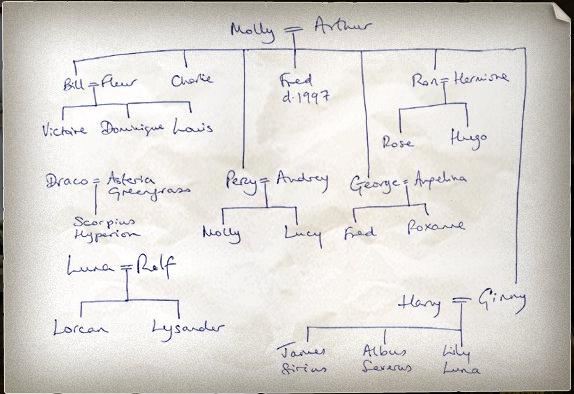
Chart of the Weasley, Potter, Malfoy, and Scamander families,
courtesy of Harry Potter Lexicon


Where did you get that red hair?

One kid I knew growing up was taught to say "from the mailman" in response to that question, because neither of his parents had red hair. But there were relatives in their extended family tree with the same phenotype - red hair and blue eyes - indicating that those recessive traits were being carried throughout the generations, but waiting to be matched with other recessive genes in order to become apparent. Because the truth of the matter is that we are all genetic combinations of our parents, grandparents, and beyond - combinations that result in physical traits that are recognizable from generation to generation.  But what lies beneath the surface - our health traits - is just as easy to spot if we think about it.

Therefore, today's HealthTwisty comes with an assignment: create a family tree. Not just one with names and dates of births and deaths, but one that includes all the health and occupational information you can mine from your family. These intergenerational facts are actually clues to your own health and can provide a road map on how to protect or enhance it.

If you've poked around HealthTwisty for awhile, you know that personal genetics or susceptibilities are the basis of much of the information here. Choices about food and our environments can work for or against our basic genetic make up, so it is important to know the genetic hand we are dealt. After all, we can't change our genetics (yet). But we can change our environments.

To get started, here are some things I'd include in a family medical history:
  • names, gender, dates of birth and death of first and second-degree family members.
  • causes of death.
  • known illnesses, allergies, and conditions, such as cancers, a penicillin allergy, arthritis, or infertility.
  • mental health issues, such as depression, addiction, or alcoholism.
  • inborn genetic issues, such as Downs syndrome or cystic fibrosis. 
  • learning issues, such as dyslexia.
  • unusual family traits, such as eyes that are different colors, premature greying, or a shock of white hair, all of which could signify underlying conditions.
  • occupations, which could account for or contribute to some diseases.
  • place of residence, such as a farm, an urban setting, or the suburbs.
  • anything else of interest.
This exercise is just a riff on what a good family physician asks about during a comprehensive exam. In recognition of the basic importance of knowing one's family history, CDC offers a computer program where family members can record and share their histories. CDC even has a campaign running in this season of family reunions that encourages people to seek health information while they are gathered together. While researching resources, I found out that the US Surgeon General has declared every Thanksgiving since 2004 as "National Family History Day" for this exact purpose. Who knew?

It's an interesting exercise. I've done a medical history for my grandparents and parents and my husband's parents and what we know of his grandparents, as well as for my husband and myself. By mapping it out, I was reassured that for the most part, both sides of my family and one branch of my husband's family generally live into their 90s in reasonably good health. But we have a lot to watch out for: different branches of our families have autoimmune diseases, cardiovascular disease, or eye problems like macular degeneration and glaucoma. Because so many of those conditions  have things you can control (like body weight to prevent diabetes) or can be screened for in order to facilitate early treatment, there are measures we can take to minimize our risks of developing them or to catch them early if they do occur.

Of course, the way genes combine is not always straightforward, which means that biology does not always equal destiny. In other words, just because one of your parents developed cancer does not mean you will. The concept of how complicated genetics can become was brought home to me years ago when I attended and wrote the report for a conference on sex and gene expression. This extremely technical conference focused on the differences in development and disease by sex and in the ways genes can be expressed. One interesting aspect called crossing-over occurs during the meiotic phase of cell division. The end result of this process is that we inherit large chunks of DNA from our grandparents. Therefore, examining your grandparents' traits may be as important as your parents' in determining your genetic make up.

Further, it is established that diseases such cancers need a series of mutational hits to form, so merely the presence of a genetic mutation that puts you at higher risk does not mean a cancer will develop.  This is why it is important to consider the environmental aspects of family members' diseases. For example, if you have a grandfather who died from lung cancer, it would be good to know if he smoked, if he worked in the construction industry where he may have been exposed to asbestos, or if he was a lawyer exposed to nothing more harmful than fumes from the copy machine. If he smoked or worked with asbestos, chances are those external factors caused his lung cancer and therefore you are not at increased risk of developing it (as long as you don't smoke or work with asbestos!).

This type of observation costs nothing more than your time spent in putting it together. You can also opt to spend some money and purchase a personalized genetic test. For about $100-$500, you can find out risk factors for certain diseases, the presence of carrying a heritable disease, and how you might react to certain drugs.

For the most part, these tests tell you that you may have the genetic makeup that predisposes you to something, but can only provide a relative chance that disease will actually develop unless the disease is a genetically dominant, like Huntington's Disease. Further, there are many steps involved in gene expression that are not captured by a recitation of the base pairs.  However, overall, these tests can be very useful - especially if you don't have information on your birth family.

Making a family history of health is not a quick process. Many people only remember what relatives died from, but not illnesses or conditions for which they may have been treated during their life. Or they may not think it important to recall that Grandpa Joe immigrated from an impoverished country where he was malnourished during his early years - a factor that could help explain his short stature and weak bones. So some probing and detective work may be required. Even only mapping your immediate family can be beneficial and may provide information to better manage your health. If you have kids, giving them a family health history can be important, not only for their current health, but in the future as the field of genetics advances in great strides.

In honor of the final Harry Potter movie, I chose the illustration at the top of this article that maps out the family trees of some of the most well-known wizards of our time. But there's nothing magic about genetics (even though there are surprises, like red hair popping up every now and then) and making a family health history can take away some of the mystery behind illnesses or just plain not feeling as well as we should. Using these clues to make sense of our own health and adjusting our environments accordingly is something even us Muggles can get behind!

###